
Every day, millions of LinkedIn comments are posted. Most add little value. A handful drive real business. The difference is not luck or follower count. It is strategy. LinkedIn comments represent one of the most powerful and least saturated channels for promoting your business, yet most professionals either ignore them entirely or use them so poorly they do more harm than good. This guide shows you exactly how to turn every comment into a subtle, effective business-building opportunity.
The Untapped Channel for Business Promotion
Consider a typical LinkedIn feed. A thought leader shares a post about sales automation trends. It gets 200 reactions and 45 comments. You read through those comments and find the same patterns: “Great post!” and “Thanks for sharing!” and maybe one or two thoughtful replies. Now imagine one of those comments adds genuine insight about the topic and naturally mentions a relevant solution. That comment gets noticed. Not just by the 45 other commenters and the post author, but by every single person who views the post and scrolls through its comments.
That is the power of comment-based promotion. Unlike creating your own posts (which compete with the algorithm for visibility), commenting on high-traffic posts gives you access to an audience that already exists and is already engaged with your topic.
LinkedIn posts from top creators routinely reach 10,000 to 500,000 impressions. When you comment on those posts with something valuable, your name, headline, and message appear in front of that entire audience. No advertising spend. No content calendar. No hoping the algorithm favors you today.
The math is simple. If you leave five thoughtful, strategically promotional comments per day on posts that each reach 20,000 people, you are getting your business in front of 100,000 potential customers daily. That is more reach than most LinkedIn posts will ever achieve, and it costs nothing but your time and expertise.
Why Are LinkedIn Comments an Underutilized Marketing Channel?
Despite their massive potential, LinkedIn comments remain one of the least optimized marketing channels for several reasons.
The effort-to-reward perception is skewed. Most marketers think of comments as a secondary activity. They invest hours into crafting the perfect post but spend seconds on comments. This is backwards for most professionals. Unless you already have 50,000+ followers, your posts reach a fraction of the audience you could access through strategic commenting on popular posts.
Self-promotion fear holds people back. Nobody wants to be the person who drops a “Check out my product!” comment under every post. The fear of appearing spammy prevents most professionals from even attempting to mention their business in comments. So they default to generic, forgettable comments that build neither visibility nor trust.
No one teaches comment-based marketing. LinkedIn marketing courses focus almost exclusively on posting, content calendars, and advertising. Comment strategy barely gets a mention. This means most people have never seen a framework for how to promote in comments without being annoying.
Scaling is difficult. Writing one thoughtful, promotional comment takes five to ten minutes. Doing that twenty times a day is a two-hour daily commitment most people cannot sustain. Without tools that help maintain quality and consistency, the channel remains underutilized.
This is exactly why the opportunity is so large. The barrier to entry is not money or connections. It is skill and consistency, and both can be augmented with the right approach and tools.
The Problem with Self-Promotion in Comments
Before discussing how to promote effectively, it is important to understand why most attempts at comment-based promotion fail. The problems fall into three categories.
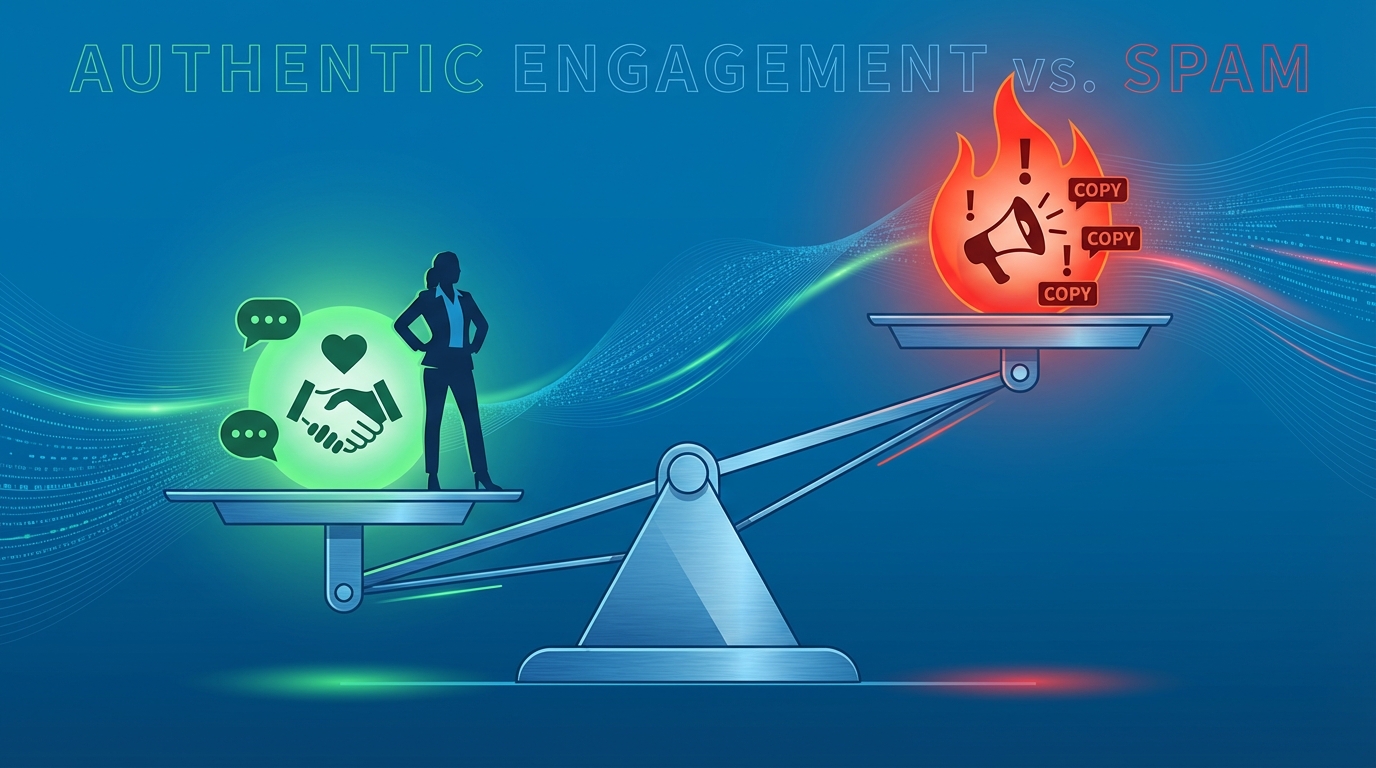
Spam and irrelevance. The most common failure is dropping a promotional comment that has nothing to do with the post. Someone shares their thoughts on remote work culture, and a commenter replies with “We help companies build mobile apps! DM me for a free consultation.” This is not promotion. It is spam. LinkedIn users report these comments, the algorithm suppresses them, and the commenter’s reputation takes a hit.
Social backlash. Even when the promotion is somewhat relevant, doing it clumsily creates negative impressions. A comment that starts with “Great insights!” and immediately pivots to “At my company, we solve this exact problem with our platform...” reads as insincere. Other commenters notice. The post author notices. You become known as the person who hijacks conversations, not the person who adds to them.
Account risk. LinkedIn’s terms of service prohibit unsolicited commercial messages and spam. Repeated promotional comments can trigger LinkedIn’s automated spam detection, resulting in comment restrictions or, in severe cases, account suspension. This is not a theoretical risk. LinkedIn has significantly increased its spam detection capabilities, and accounts that post repetitive promotional content face real consequences.
The solution is not to avoid promotion entirely. That leaves business value on the table. The solution is to promote in a way that adds value, matches the conversation, and varies enough that it never triggers spam patterns. This is precisely what non-spammy self-promotion frameworks are designed to achieve.
How Smart Promotion Works: AI-Powered Contextual Business Mentions
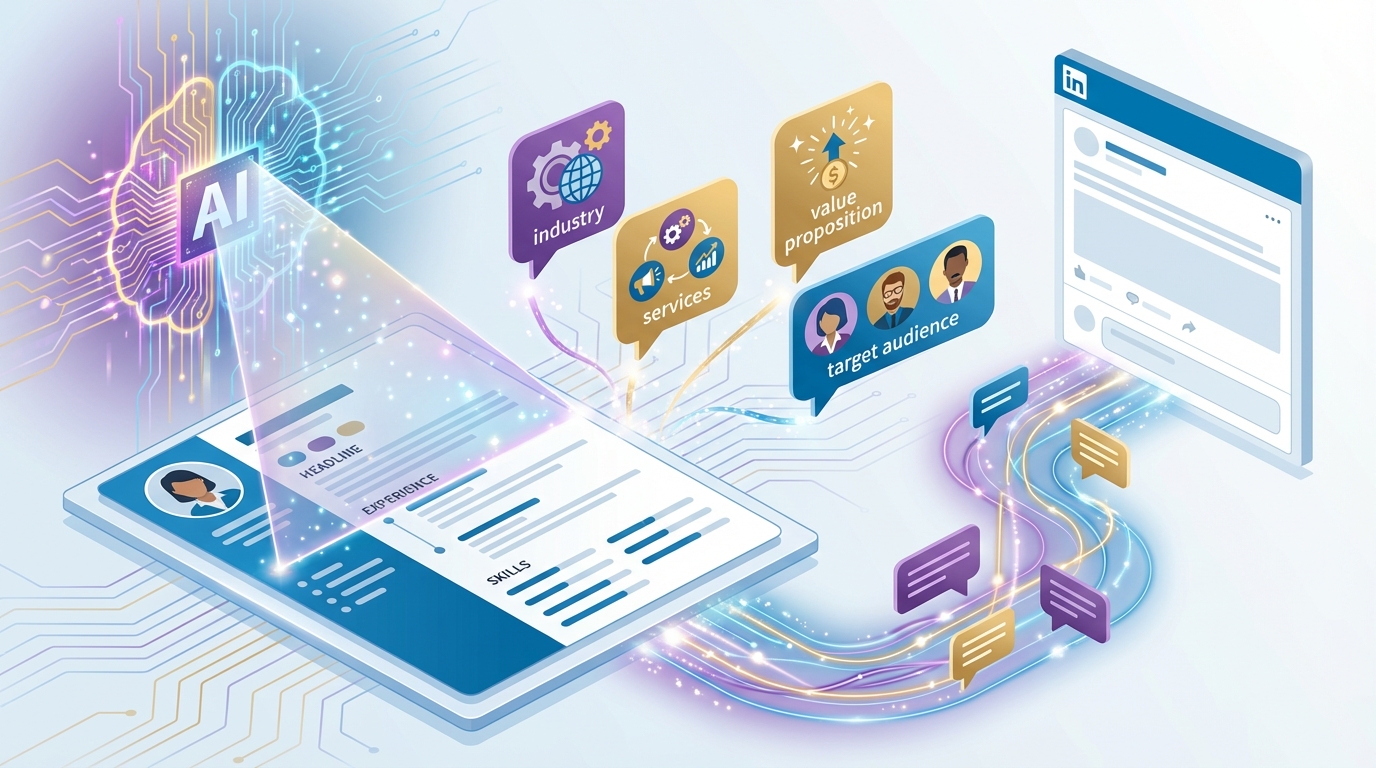
Smart Promotion is a feature within LinkedReply that uses AI to weave contextual business mentions into approximately 20% of the comments you generate. Rather than appending a boilerplate pitch to every comment, the system analyzes the post content, evaluates topical relevance to your business, and then crafts a response that contributes genuine value while naturally referencing your expertise, product, or service.
The process works in five stages:
- Post analysis. The AI reads the full post content, including any images or documents, and identifies the core topics, themes, and intent. Is this a post about marketing technology? Sales processes? Leadership challenges? Career advice?
- Business profile matching. Your Business Profile contains information about your expertise, your company’s offering, key resources, and target audience. The AI compares the post’s topics against your profile to determine if there is a natural overlap.
- Promotion decision. Based on relevance score, your frequency settings, and safety checks, the AI decides whether this particular comment should include a business mention. Not every comment gets one. That selectivity is what makes it effective.
- Style selection. If promotion is appropriate, the AI selects the right promotion style (subtle, balanced, or direct) based on the relevance strength and the post context.
- Comment generation. The AI generates a complete comment that leads with value and integrates the business mention naturally. The promotion feels like part of the conversation, not an interruption.
This pipeline ensures that every promotional comment passes the “would a real expert say this?” test. The business mention exists because it genuinely adds context, not because it was forced into the comment.
Three Promotion Styles: Subtle, Balanced, and Direct
Not every promotional opportunity is the same. A comment on a post about a broad industry trend calls for a different approach than a comment on a post specifically asking for tool recommendations. Smart Promotion offers three distinct styles to match every situation.
Subtle Promotion Style
The subtle style weaves your expertise into the comment without explicitly naming your company or product. It positions you as a knowledgeable professional whose perspective clearly comes from deep domain experience. Readers who want to learn more will click your profile and discover your business organically.
When to use it: Posts about broad industry topics, thought leadership discussions, or any conversation where a direct product mention would feel out of place.
Example post: “Why I think AI will change B2B sales forever. Here are 5 trends I’m watching...”
Without Smart Promotion:
“Great points about AI in sales. The trend around conversational intelligence is particularly interesting. I think we’ll see more adoption in mid-market companies by Q3.”
With Subtle Promotion:
“Point #3 about personalization at scale is where I see the most immediate impact. We’ve been helping sales teams implement exactly this approach, and the results are striking: reply rates increase 3-4x when outreach is genuinely tailored vs. template-based. The teams that adopt early are building a significant competitive moat.”
Notice the difference. The subtle version references relevant experience and results without naming a company or product. It invites curiosity. The reader thinks, “This person clearly works on this problem. Let me check their profile.”
Balanced Promotion Style
The balanced style adds a brief, relevant reference to your business or a resource you offer, positioned as additional context rather than a pitch. It strikes the middle ground between pure thought leadership and explicit promotion.
When to use it: Posts about specific problems your business solves, industry discussions where your product category is relevant, or conversations where sharing a resource would be helpful.
Example post: “LinkedIn commenting takes me 2 hours a day. Is it worth the time? Here’s my ROI analysis...”
Without Smart Promotion:
“The ROI is definitely there. I’ve tracked my LinkedIn engagement for six months and comments consistently drive more profile views and connection requests than posts. The key is consistency.”
With Balanced Promotion:
“The ROI is definitely there, but 2 hours is a lot. I had the same time problem until I started using AI-assisted commenting (LinkedReply in my case) to handle the first draft. Now I spend about 30 minutes reviewing and personalizing instead of writing from scratch. Same quality, a quarter of the time. Your ROI numbers would look even better with that time savings factored in.”
The balanced version names the tool but frames it as a personal solution to the exact problem being discussed. It adds value (a specific time-saving tactic) while mentioning the product as part of the narrative.
Direct Promotion Style
The direct style includes an explicit mention of your product, service, or a specific resource, with a clear reason why it is relevant to the conversation. This is reserved for posts where the topic directly overlaps with your offering and a direct mention feels natural.
When to use it: Posts asking for tool recommendations, discussions about a problem your product directly solves, or threads where other commenters are already sharing solutions.
Example post: “What tools are you using for LinkedIn engagement in 2026? Looking for recommendations.”
With Direct Promotion:
“I’ve been using LinkedReply for about four months. What sold me was the Write Like Me feature that learns your writing style, so comments don’t sound generic. It also has a Business Profile feature that can weave in subtle mentions of your expertise when relevant. I was skeptical about AI comments, but the quality is genuinely good. Worth checking out the free tier to test it.”
The direct version works here because the post is specifically asking for recommendations. A product mention is expected and welcome. Avoiding promotion on a post like this would actually be a missed opportunity.
Setting Up Your Business Profile for Maximum Impact
The quality of Smart Promotion depends heavily on the information you provide in your Business Profile. Think of it as giving the AI the raw materials it needs to promote your business intelligently. Here is what matters most.
Your expertise description. This is the foundation. Describe what you do in specific, concrete terms. Not “I help businesses grow” but “I help B2B SaaS companies reduce churn by implementing customer success automation using predictive analytics.” The more specific you are, the better the AI can identify which posts align with your expertise.
Your key offerings. List the specific products, services, or solutions you want to promote. Include what makes each one distinctive. If you have a free tool, report, or resource that provides immediate value, include it here. The AI can reference these as helpful resources rather than sales pitches.
Your target audience. Who are you trying to reach? Defining your ideal customer profile helps the AI select the right posts for promotion. If you sell to HR leaders at enterprise companies, the AI will prioritize promotional comments on posts by and for that audience.
Key results and proof points. Numbers and specific outcomes make promotional comments credible. “We helped a client reduce onboarding time by 60%” is far more compelling than “We improve onboarding.” Include your best case study metrics, customer counts, or industry recognition.
Topics you are an authority on. List five to ten specific topics where you have genuine expertise. The AI uses these to determine topic-relevance matching, which is the core of deciding when to promote.
Spending 15 minutes on a thorough Business Profile setup dramatically improves the quality and effectiveness of every promotional comment the AI generates. See our pricing page for which plans include the Business Profile and Smart Promotion features.
Topic-Relevance Matching: How AI Decides When to Promote
Smart Promotion does not add business mentions to every comment. It uses topic-relevance matching to determine which posts represent genuine promotion opportunities and which do not.
The AI evaluates relevance on a scale from 0 (no connection between the post topic and your business) to 1 (the post is directly about your product category or a problem you solve). Based on this score, different promotion behaviors are triggered.
Low relevance (0 to 0.3): No promotion. The comment is purely value-driven. If someone posts about their morning routine, and you sell accounting software, there is no natural connection. The AI provides a thoughtful comment with no business mention.
Medium relevance (0.3 to 0.6): Subtle promotion only. There is some thematic overlap, but not enough for a direct mention. The AI references your expertise or experience without naming your product. A post about “scaling a finance team” might trigger a subtle mention if you sell accounting software because the topic is adjacent.
High relevance (0.6 to 1.0): All promotion styles available. The post topic closely matches your offering. A post about “choosing the right accounting automation tool” would score high, and the AI could use balanced or direct promotion depending on your preferences.
This scoring system means you never promote on irrelevant posts. Your business mentions only appear when they genuinely contribute to the conversation, which is exactly what makes them effective rather than annoying.
Frequency Controls and Safety Guardrails
Even when promotion is relevant, too much of it creates problems. Smart Promotion includes frequency controls and safety guardrails to prevent over-promotion.
Promotion frequency setting. You control what percentage of your comments include business mentions. The default is approximately 20%, meaning one in five comments includes some form of promotion. You can adjust this up or down based on your goals and comfort level.
Cooldown periods. The system tracks when your last promotional comment was posted and ensures appropriate spacing. You will never see two promotional comments in a row, regardless of how relevant the posts are.
Sensitive topic detection. The AI identifies posts about sensitive subjects and automatically disables promotion on those comments. Sensitive topics include:
- Layoffs, job losses, and company closures
- Health issues, illness, or bereavement
- Personal tragedies or hardships
- Discrimination, harassment, or social justice issues
- Natural disasters or crisis events
- Memorial or tribute posts
Promoting your business on a post about someone losing their job would be tone-deaf at best and reputation-destroying at worst. The safety system ensures this never happens.
Pattern variation. The AI varies the structure, phrasing, and placement of promotional mentions across comments. No two promotional comments use the same template. This prevents the repetitive patterns that LinkedIn’s spam detection looks for and that human readers find off-putting.
Post author consideration. The system considers the relationship between you and the post author. If you frequently comment on someone’s posts, it reduces promotion frequency on their content to avoid damaging the relationship.
Real Examples: Smart Promotion in Action
The best way to understand Smart Promotion is through examples across different industries.
Example 1: SaaS Marketing Consultant
Post topic: “Our startup hit $1M ARR but our content marketing isn’t working. What should we focus on next?”
Before (generic comment):
“Congrats on the milestone! Content marketing takes time to build momentum. Keep at it.”
After (Smart Promotion, balanced style):
“Congrats on $1M ARR, that is a real inflection point. At this stage, the content marketing challenge is usually not volume but distribution. I’ve worked with about 30 SaaS companies at this revenue stage, and the pattern is consistent: the content is fine, but it is not reaching the right people. Two things that move the needle: (1) commenting strategy on LinkedIn targeting your ICP’s content, and (2) co-marketing with complementary tools. I wrote a framework for this exact scenario. Happy to share if useful.”
This response demonstrates expertise, provides specific advice, and offers a resource without being pushy.
Example 2: Cybersecurity Firm
Post topic: “Our company just got phished. Sharing what we learned to help others avoid the same mistake.”
Before (generic comment):
“Thanks for sharing this. Phishing is getting more sophisticated every day. Everyone should be careful.”
After (Smart Promotion, subtle style):
“Thanks for sharing the specifics. Point 3 about the spoofed domain is crucial. We see this exact attack vector in about 40% of incidents we investigate. One additional safeguard worth mentioning: DMARC enforcement at the p=reject level catches most of these before they reach inboxes. The hardest part is getting full SPF alignment first, especially if you use multiple email platforms. But the reduction in successful phishing attempts is dramatic.”
The subtle style shows deep expertise (“40% of incidents we investigate”) without naming the firm, inviting the reader to explore the commenter’s profile.
Example 3: Executive Coach
Post topic: “Looking for recommendations on executive coaching programs. My VP of Sales is struggling with the transition from IC to manager.”
After (Smart Promotion, direct style):
“This transition is one of the most common pain points I work on with clients. The IC-to-manager shift fails most often because the new manager keeps doing the IC work instead of coaching their team. Two things that help: (1) a structured 1:1 framework that forces coaching conversations, and (2) role-specific metrics that measure team output rather than individual contribution. I run a 12-week coaching program specifically for new sales managers making this transition. Happy to share more details if your VP is interested.”
Direct promotion works here because the post is explicitly asking for recommendations. The coach provides actionable advice first, then offers their service as a logical next step.
Example 4: When Smart Promotion stays silent
Post topic: “Today I was laid off after 8 years at the company. Feeling lost but grateful for the journey.”
Smart Promotion output:
“Eight years is a significant chapter, and it is completely normal to feel lost at this stage. The skills and relationships you built during that time do not disappear when the role ends. Give yourself space to process this, and when you are ready, your network is clearly behind you. Wishing you the best in whatever comes next.”
No promotion. No expertise reference. No business mention. The safety guardrails detected a sensitive topic and generated a purely empathetic, human response.
Measuring Business Impact from Comment-Based Promotion
Smart Promotion drives business results through a measurable funnel. Here is how to track the impact.
Profile views. The most immediate metric. When your comment resonates, readers click your profile. Track your weekly profile view count on LinkedIn and correlate it with your commenting activity. Most users see a 3-5x increase in profile views within the first two weeks of consistent strategic commenting.
Connection requests. Quality comments from an expert perspective generate connection requests from people who want more of your insights. Track the number and quality of incoming connection requests. Are they from your target audience?
Direct messages. The strongest signal. When someone reads your promotional comment, visits your profile, and then sends you a message asking about your product or service, that is a warm lead generated entirely from commenting. Track these conversations and their conversion rate.
Website traffic. If your promotional comments include links to resources (and some should), track referral traffic from LinkedIn. Use UTM parameters on any links you share to attribute traffic accurately.
Revenue attribution. The ultimate metric. When you close a deal, ask how the customer first encountered your business. A growing number of B2B buyers report that LinkedIn comments were their first touchpoint with a vendor. Build this question into your sales process.
The typical progression looks like this: consistent commenting drives profile views, which generate connection requests, which create DM conversations, which convert to calls, which close deals. The cycle takes 30 to 90 days to produce measurable revenue, but the pipeline value starts building from day one.
For a comprehensive approach to LinkedIn commenting that includes both organic engagement and strategic promotion, see our complete LinkedIn commenting strategy guide.
Your next step. Set up your Business Profile in LinkedReply, choose your promotion frequency and style preferences, and start commenting on posts in your industry. Within a week, you will see the difference between random commenting and strategic, AI-powered promotion. The opportunity is massive, and most of your competitors have not figured this out yet.