
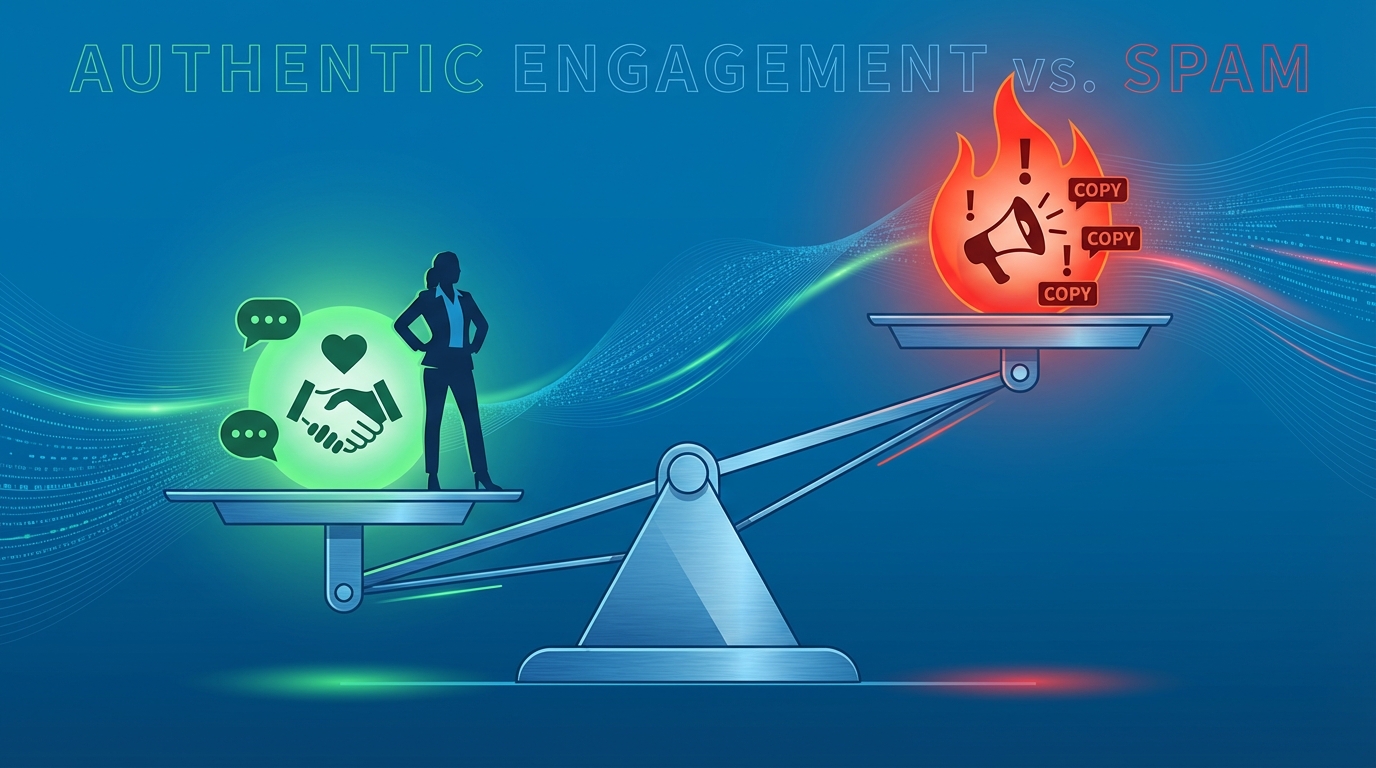
You know you should be promoting your business on LinkedIn. You also know that nobody likes the person who turns every comment section into a sales pitch. This tension paralyzes most professionals. They either avoid self-promotion entirely (missing real business opportunities) or do it so clumsily that it backfires. This guide shows you how to occupy the middle ground: promoting yourself effectively while earning respect rather than eye rolls.
There Is a Fine Line Between Thought Leadership and Spam
LinkedIn is the only major social platform where overt professional self-promotion is somewhat expected. People announce job changes, share company milestones, and celebrate wins. Yet even on LinkedIn, there is a clear boundary between acceptable promotion and behavior that alienates your network.
The difference comes down to a single principle: does your promotion add value to the person reading it, or does it only serve you?
A comment that says “We just launched a new feature that does X” under a relevant post is informative. A comment that says “Check out our product!” under every post is spam. Same person, same product, completely different reception. The content of the promotion matters, but the context matters more.
The professionals who self-promote effectively on LinkedIn have figured out something important: promotion is not an action you take. It is a byproduct of consistently sharing expertise. When you comment with genuine insight, your expertise promotes itself. The business mention, when it comes, feels like a natural extension of your knowledge rather than an interruption.
Why Does Self-Promotion on LinkedIn Feel So Awkward?
Before fixing the problem, it helps to understand why self-promotion feels uncomfortable for most professionals.
Cultural conditioning. Most of us were raised with the idea that modesty is a virtue and bragging is distasteful. This carries into our professional lives, making us reluctant to draw attention to our own work even when doing so would be genuinely helpful to others.
Negative examples are everywhere. We have all seen terrible self-promotion on LinkedIn: the generic pitch dropped under a grief post, the person who replies “DM me for a free consultation” to everything, the founder whose every comment reads like a press release. These examples set a negative anchor that makes us associate all self-promotion with spam.
The feedback loop is delayed. When you write a good comment with no promotion, you get immediate positive feedback: likes, replies, and a sense of contributing value. When you add promotion, the feedback is ambiguous. Did people like the comment or tolerate the promotion? This uncertainty makes the behavior feel risky.
The stakes are real. Unlike posting to an anonymous forum, your LinkedIn activity is tied to your professional identity. A poorly received promotional comment is visible to colleagues, clients, and potential employers. The reputational risk, even if small, looms large.
Understanding these psychological barriers is the first step to overcoming them. The awkwardness is not a sign that you should avoid promotion. It is a sign that you need a framework for doing it well.
The Self-Promotion Spectrum: From Invisible to Obnoxious
Self-promotion on LinkedIn exists on a spectrum. Most people operate at the extremes. The goal is to find the productive middle.
Level 0: Invisible. You comment frequently but never reference your work, expertise, or business. Your comments are thoughtful but interchangeable with anyone else’s. People appreciate your contributions but have no idea what you do or how you could help them. Missed opportunity.
Level 1: Implied expertise. Your comments demonstrate deep domain knowledge without explicitly naming your company or product. Readers can infer that you work in the space and might check your profile. This is good but leaves too much to chance.
Level 2: Contextual reference. You occasionally mention your work, company, or a specific result when it is directly relevant to the conversation. The promotion serves the discussion. This is the sweet spot for most professionals.
Level 3: Balanced promotion. You regularly reference your business in comments but always pair it with genuine value. You might share a link to a free resource, mention a relevant case study, or describe how your approach differs. The promotion is overt but useful. This works well when done selectively.
Level 4: Direct pitch. Most comments include an explicit mention of your product, a call-to-action, or a sales message. Even when the content is relevant, the frequency and directness create fatigue. Your network starts scrolling past your comments.
Level 5: Spam. Every comment is a generic pitch regardless of the post topic. Copy-paste messages, irrelevant links, and aggressive CTAs. This damages your reputation and risks account restrictions.
The productive range is Level 1 through Level 3, with most of your comments at Level 1 or 2 and occasional forays into Level 3 when the context genuinely calls for it.
Rules for Self-Promotion That LinkedIn Users Actually Appreciate
Based on analysis of thousands of high-performing LinkedIn comments, these rules separate effective self-promotion from the kind that generates negative reactions.
Rule 1: Lead with insight, not identity. Never start a comment with “At [Company], we...” Start with a genuine observation, insight, or piece of advice. If you mention your company, it should come after you have already provided value.
Rule 2: The promotion must be removable. Here is the test: if you deleted the promotional sentence from your comment, would the comment still be valuable? If yes, the promotion is well-placed. If removing it leaves nothing of substance, you wrote a pitch, not a comment.
Rule 3: Match the emotional register of the post. If the post is celebratory, celebrate first, then add context. If the post is asking for advice, give advice first, then reference your experience. If the post is vulnerable or emotional, respond with empathy only. Never promote on emotional posts.
Rule 4: Be specific, not generic. “We help businesses grow” is meaningless. “We helped a Series A fintech company reduce their CAC by 35% in three months using LinkedIn content distribution” is specific, credible, and interesting. Specific claims invite curiosity. Generic claims invite skepticism.
Rule 5: Offer, do not push. There is a massive difference between “DM me to learn more” and “Happy to share the framework we used if it would be useful.” The first is a push. The second is an offer. Offers respect the reader’s autonomy and are received far more positively.
Rule 6: Vary your approach. Even good promotional comments become annoying if they follow the same pattern every time. Mix up your structure, your level of promotion, and which aspects of your business you reference. This is one area where common commenting mistakes catch many people: using the same promotional template repeatedly.
Rule 7: Earn the right to promote. If you have never commented on someone’s posts before, your first comment should not be promotional. Build a relationship first. Comment with pure value two or three times. Then, when you do include a business mention, it comes from someone the post author recognizes and respects.
The 80/20 Rule: Value First, Promote Second
The 80/20 rule is the simplest framework for sustainable self-promotion on LinkedIn. Eighty percent of your comments should provide pure value with no promotional intent. Twenty percent can include some form of business mention.
In practice, this means that for every five comments you write, four should be entirely focused on contributing to the discussion. Answering questions, sharing insights, adding context, challenging assumptions, or offering a different perspective. The fifth comment can include a natural reference to your business, expertise, or a resource you offer.
Why 80/20 specifically? Two reasons.
First, it builds a track record. When someone sees your name in a comment section, their first thought should be “this person always has something smart to say,” not “here comes another pitch.” The 80% of value-only comments establishes this reputation.
Second, it makes the 20% more effective. A promotional comment from someone who consistently provides value is received completely differently than one from someone who only promotes. The value comments give your promotional comments credibility by association.
This ratio also protects you from LinkedIn’s spam detection systems, which look for accounts that post repetitive promotional content. A 20% promotion rate, with varied messaging, stays well below the threshold that triggers flags.
The challenge, of course, is maintaining this ratio consistently. It is easy to slip into promoting more often when business is slow or when you see a particularly relevant post. This is one of the reasons tools with built-in frequency controls are valuable: they enforce the ratio automatically.
10 Examples of Non-Spammy Self-Promotion in Comments
Theory is useful, but examples make it real. Here are ten promotional comments that add value while mentioning a business, organized by scenario.
1. Sharing a relevant result
“This matches what we found when we tested this with three enterprise clients last year. The avg. deal cycle shortened by 22 days when SDRs engaged with prospects’ content before outreach. The key was genuine engagement, not just liking posts to show up in their notifications.”
2. Offering a free resource
“Really solid framework for content repurposing. One thing I would add: the LinkedIn version needs to be rewritten for the feed, not just truncated. We put together a free repurposing checklist that covers the platform-specific edits. Happy to drop the link if anyone wants it.”
3. Adding industry expertise
“Interesting take on the compliance angle. Having worked in fintech compliance for the past six years, I would add that the CFPB guidance on this is still evolving. The conservative approach is to treat AI-generated financial advice the same as human advice from a regulatory standpoint until the rules are clarified. We published a compliance checklist for this exact scenario last month.”
4. Respectfully disagreeing with data
“Appreciate the analysis, but the 5% response rate benchmark might be low for this segment. In our outreach campaigns to VP+ level in tech companies, we consistently see 12-15% when the first touch is a relevant comment on their post rather than a cold InMail. The warming makes a significant difference.”
5. Answering a question with experience
“We faced the same challenge scaling from 10 to 50 reps. What worked for us was separating the onboarding into two tracks: product knowledge (self-serve, video-based) and selling motion (live, role-play heavy). Cut ramp time from 90 days to 45. The biggest unlock was recording and sharing top performers’ actual discovery calls as training material.”
6. Providing a contrarian take
“Respectfully pushing back on point 3. In our experience building onboarding flows for B2B SaaS, shorter onboarding does not always mean better. For complex products, rushing users to the aha moment can actually increase churn if they skip foundational steps. The metric to optimize is time-to-value, not time-to- completion.”
7. Validating with social proof
“This is exactly right. We ran a similar experiment with our 200+ agency clients and saw that personalized LinkedIn comments generated 4x more profile visits than personalized connection requests. The comment-first approach works because it is public social proof rather than a private message.”
8. Expanding on the post with a use case
“Great framework. One application I have not seen discussed enough: using this approach for recruiting. We adapted this exact strategy for talent acquisition teams, and they are seeing candidate response rates 3x higher than traditional InMail outreach. The candidates feel like they are joining a conversation, not receiving a pitch.”
9. Citing specific data from your work
“The timing data here is interesting. Our analysis of 50,000 LinkedIn comments posted by our users shows that comments posted within the first 30 minutes of a post going live get 5x more visibility than those posted after 2 hours. Early commenting is the single most underrated LinkedIn growth lever.”
10. Connecting the topic to your expertise
“This resonates deeply. As someone who builds AI tools for professional communication, I can confirm that the biggest challenge is not generating content. It is generating content that sounds like a specific human rather than a generic AI. That is why voice matching and personalization are where the real innovation is happening in this space.”
Notice the pattern across all ten examples. Every comment leads with value. The business reference is woven into the insight, not bolted onto it. Most readers would not even register these as “promotional” because the information stands on its own.
How Smart Promotion AI Solves the Self-Promotion Dilemma
The challenge with the frameworks above is consistency. Crafting thoughtful, contextually promotional comments takes time and creative energy. Maintaining the right ratio, varying your approach, and avoiding sensitive topics requires constant vigilance. This is where AI changes the equation.
LinkedReply’s Smart Promotion feature automates the entire self-promotion framework.
It maintains the ratio automatically. Set your preferred promotion frequency (the default is 20%), and the system ensures you never over-promote. Four out of five comments will be pure value. The fifth will include a natural business mention when topically appropriate.
It matches promotion to context. The AI analyzes each post to determine whether your business is relevant to the topic. If there is no natural connection, it skips promotion entirely for that comment, regardless of your frequency settings.
It varies the approach. The system uses three distinct promotion styles (subtle, balanced, and direct) and varies the structure and phrasing across comments. No two promotional comments read the same way.
It respects sensitive boundaries. The AI automatically detects sensitive topics (layoffs, health issues, personal tragedies) and disables all promotion on those comments. You never have to worry about tone-deaf self-promotion appearing on the wrong post.
It uses your actual expertise. Your Business Profile feeds the AI your real expertise, offerings, and proof points. The promotional mentions reference your actual work, not generic claims.
The result is self-promotion that follows every rule in this guide, applied consistently across dozens of comments daily, without the mental effort of doing it manually. You review and personalize each comment before posting, but the heavy lifting of balancing value and promotion is handled by the AI.
Building Trust Before You Promote (The Engagement Ladder)
The most effective self-promoters on LinkedIn follow an unspoken sequence. They do not promote to strangers. They promote to people who already recognize and respect them. This sequence is the engagement ladder.
Step 1: Show up consistently. Before you promote anything, establish a presence. Comment on posts from your target audience, industry peers, and thought leaders in your space. Make your comments thoughtful and unique. Do this for at least two weeks with no promotional intent.
Step 2: Build recognition. At this stage, the people whose posts you comment on start recognizing your name. They react to your comments. They might even reply. You are becoming part of their LinkedIn community. Still no promotion.
Step 3: Establish expertise. Your comments consistently demonstrate deep knowledge about specific topics. People start associating your name with that expertise. They might tag you in relevant discussions. You are now a trusted voice, not a stranger.
Step 4: Introduce contextual promotion. Now, when you mention your business in a comment, it lands differently. The post author knows you. Other commenters recognize you. Your promotion comes from a position of established credibility. It reads as a helpful reference from an expert, not a pitch from a stranger.
Step 5: Deepen relationships. The best outcomes come from ongoing engagement. Continue the 80/20 balance. As relationships deepen, your promotional comments become even more effective because they come from someone the audience genuinely trusts.
This ladder takes time to climb, but it produces results that no amount of aggressive promotion can match. A single promotional comment from a trusted, recognized expert generates more business impact than a hundred generic pitches from a stranger.
For a deeper look at building your personal brand through commenting, see our dedicated guide.
The bottom line. Self-promotion on LinkedIn is not about choosing between business results and professional reputation. Done right, each reinforces the other. Your insights build your reputation. Your reputation makes your promotion more effective. Your promotion drives business results that give you more insights to share. It is a virtuous cycle, and it starts with a single rule: lead with value, always.
Ready to implement non-spammy self-promotion at scale? See how LinkedReply works and start with the free tier to experience the difference.