
Every content creator on LinkedIn faces the same frustrating chicken-and-egg problem: you need an audience to get reach, but you need reach to build an audience. How do you break through when you are starting from zero, or when your growth has plateaued? The answer is not creating more content. It is commenting more strategically on other people's content.
The top LinkedIn creators, the ones with 50,000 or more followers and posts that consistently go viral, all share a common origin story. Before they were known for their posts, they were known for their comments. Strategic commenting is the secret growth lever that most creators overlook because it does not feel like "creating content." But it is the most reliable path to building an engaged LinkedIn following.
This guide breaks down exactly how content creators can use commenting as a primary growth strategy, with specific frameworks, examples, and a phase-by-phase plan for growing from 0 to 10,000 followers.
Why Do Content Creators Who Comment Get More Followers?
There is a direct, measurable relationship between commenting activity and follower growth on LinkedIn. Creators who comment consistently grow 2 to 5 times faster than those who only post. Here is why:
The discovery problem. LinkedIn does not have a robust discovery mechanism for new creators. There is no "Explore" page like Instagram or a "For You" feed like TikTok. The primary way new people find you on LinkedIn is through your comments on other posts. When your comment appears under a post by someone with 100,000 followers, thousands of people who have never heard of you are suddenly exposed to your thinking.
Demonstrated value. A post is a one-way broadcast. A comment is a demonstration of your thinking in context. When someone reads your insightful comment on a topic they care about, they do not just see your words. They see how your mind works, how you engage with others' ideas, and whether you have anything unique to offer. This is often more compelling than a standalone post.
Reciprocity mechanics. When you leave thoughtful comments on another creator's posts, they notice. Most creators check their comments regularly, and they develop a sense of loyalty toward people who consistently engage with their work. This leads to reciprocal engagement: they comment on your posts, share your content, and mention you in their own content. This cross-pollination effect accelerates growth for both parties.
Algorithm training. LinkedIn's algorithm learns from your engagement patterns. When you comment on posts in a specific niche, the algorithm begins showing your content to people who engage with similar topics. Your commenting activity literally trains LinkedIn to distribute your posts to the right audience.
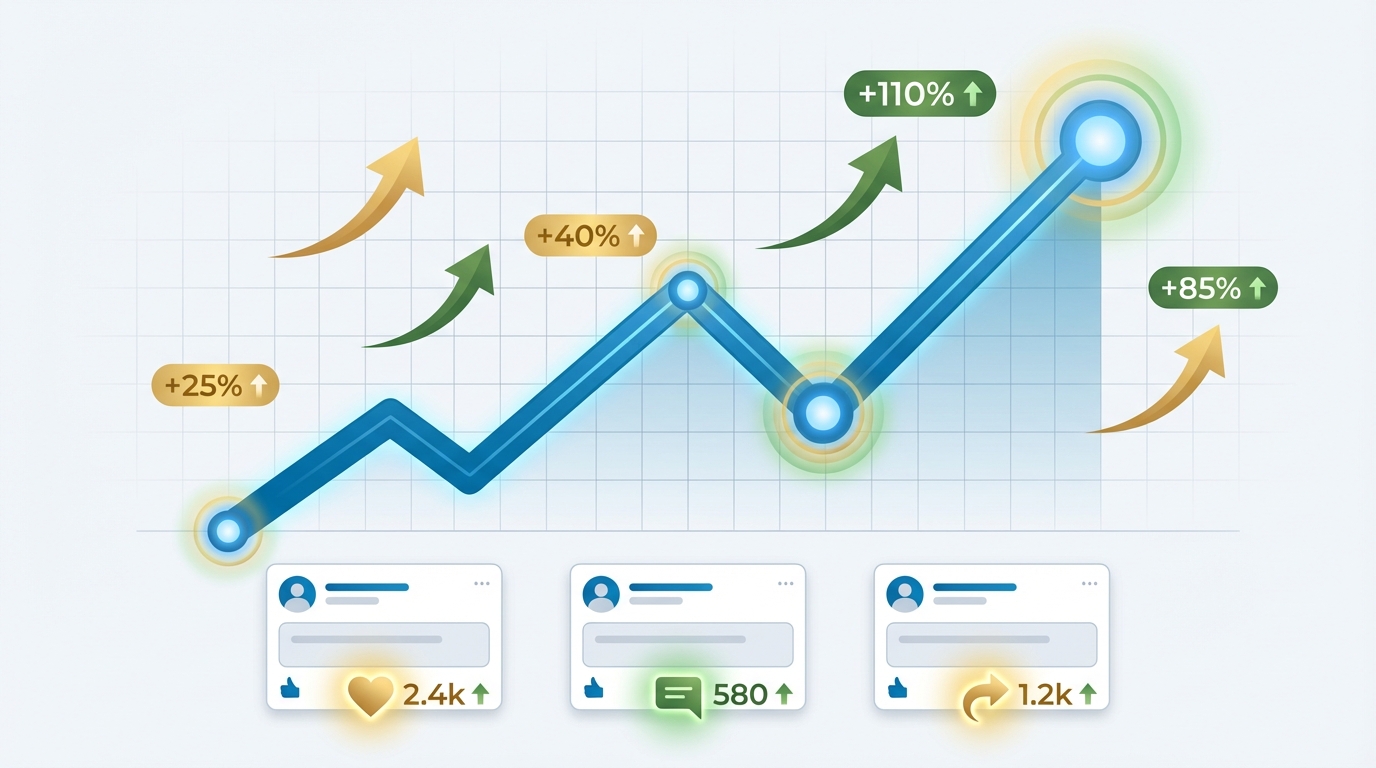
A creator who spends 30 minutes commenting before they publish a post will typically see 40% to 80% more reach on that post compared to publishing without prior engagement. The algorithm sees you as an active, engaged user and rewards you with distribution. According to recent LinkedIn engagement rate research, this pre-engagement commenting is one of the strongest predictors of post performance.
The Comment-First Growth Strategy
The comment-first strategy flips conventional LinkedIn advice on its head. Instead of "create great content and the audience will come," you start with engagement and let audience growth follow naturally.
Step 1: Engage Before You Publish
Before you publish any piece of content, spend 15 to 20 minutes engaging with posts in your niche. This serves multiple purposes:
- Algorithm priming. Your engagement signals to LinkedIn that you are active, which boosts the visibility of your next post.
- Audience warming. The people who see your comments may visit your profile and be ready to engage with your post when it appears in their feed.
- Idea validation. Engaging with current conversations ensures your upcoming post is topically relevant to what people are discussing today.
- Relationship building. Creators whose posts you engage with are more likely to reciprocate when your post goes live.
The practical routine looks like this: Open LinkedIn 20 minutes before your scheduled posting time. Leave 5 to 8 thoughtful comments on posts in your niche, prioritizing posts by creators with larger audiences. Then publish your content and immediately return to engaging with new posts.
Step 2: Post, Then Double Down on Engagement
After publishing your content, spend another 15 minutes engaging. This time, your commenting strategy has a dual purpose: continuing to build relationships and driving people back to your newly published post through increased profile visibility.
Reply to every comment on your own post within the first hour. This signals to the algorithm that your post is generating meaningful conversation, which boosts its distribution. Then return to commenting on other posts, keeping your name and face active across the platform.
Creators who follow this before-and-after engagement pattern consistently report that their posts reach 2 to 3 times more people compared to publishing without any surrounding engagement activity.
Finding the Right Posts to Comment On
Not all posts are worth your commenting time. Strategic targeting is what separates creators who grow from those who stay stuck.
Niche Targeting: Quality Over Quantity
Your comments should be concentrated in your content niche. If you create content about B2B marketing, your comments should appear on posts about B2B marketing, content strategy, demand generation, and related topics. Spreading your comments across unrelated topics dilutes your brand and confuses the algorithm about what audience to show your content to.
Build a target list of 40 to 50 accounts in your niche across three tiers:
- Tier 1 (5 to 10 accounts): Major influencers. These are the creators with 50,000 or more followers whose posts consistently get hundreds of comments. Getting a visible comment on their posts gives you maximum exposure. The competition for attention is high, so your comments need to be exceptional.
- Tier 2 (15 to 20 accounts): Rising creators. These are creators with 5,000 to 50,000 followers who are growing quickly. Their posts get enough engagement to give you good visibility, but there is less competition for top comments. These creators are also more likely to notice and reciprocate your engagement.
- Tier 3 (15 to 20 accounts): Peers and emerging voices. These are creators at your level or slightly above. Engaging with their content builds genuine peer relationships that lead to collaboration, cross-promotion, and mutual growth.
Distribute your commenting time across all three tiers. A good daily ratio is 2 to 3 comments on Tier 1 posts, 3 to 4 on Tier 2, and 3 to 4 on Tier 3.
Identifying High-Impact Posts
Within your target accounts, prioritize posts that match these criteria:
Published within the last 2 hours. Early comments get dramatically more visibility because they appear at the top of the comment section when the post is getting its initial distribution. LinkedIn's algorithm also uses early engagement signals to determine how widely to distribute a post, meaning your early comment helps the post go further, and your comment rides that wave.
Controversial or opinion-heavy topics. Posts that take a strong stance generate more discussion. Your comment on a controversial post is more likely to spark a thread that keeps your name visible for hours as people reply.
Question-based posts. When a creator asks a question, they are inviting engagement. Your thoughtful answer is welcome, valued, and often highlighted by the original poster. Many creators will pin or reply to the best answers, giving your comment even more visibility.
Posts with high initial engagement signals. If a post has gotten 50 or more reactions in its first hour, it is likely going to be widely distributed. Getting your comment on this type of post early maximizes your exposure.
Creator Comment Frameworks
As a content creator, your comments should showcase your unique perspective and give people a reason to follow you. Here are three proven frameworks that consistently generate follows.
The Storytelling Framework
Storytelling comments are powerful because they are memorable. While most comments offer abstract opinions, a story anchors your insight in concrete experience.
The structure is simple: Hook + Story + Insight.
Hook: Open with a line that connects to the post and creates curiosity. "This happened to me last year, and the outcome surprised everyone."
Story: Share a brief (3 to 4 sentence) story from your experience that relates to the post's topic. Include specific details: names of companies, numbers, timelines, or outcomes. Specificity makes stories believable and memorable.
Insight: Close with the lesson or principle that your story illustrates. This is the takeaway that makes your comment valuable, not just entertaining.
Example on a post about content marketing ROI:
This hits close to home. Last quarter, we shifted 40% of our content budget from gated ebooks to ungated educational posts on LinkedIn. Everyone on the team predicted it would kill our lead numbers. Instead, demo requests went up 65% because prospects were coming in pre-educated and ready to buy. The lesson: sometimes the best lead magnet is giving away your expertise without a gate. Trust compounds faster than email lists.
The Case Study Framework
Case study comments provide concrete evidence for or against the post's claims. They position you as someone with real-world results, not just theories.
Structure: Context + Method + Result + Principle.
Context: Briefly set the scene. What was the situation or challenge?
Method: What approach did you or your team take?
Result: What was the measurable outcome?
Principle: What broader lesson can others apply?
Example on a post about hiring challenges:
We tested this at our agency last year. Instead of posting job descriptions, we started sharing "day in the life" content showing what working with our team actually looks like. Raw, unpolished, real. Applications increased by 3x, but more importantly, quality of applicants improved dramatically. People were self-selecting based on genuine culture fit rather than keywords. The principle: show, do not tell, when it comes to employer branding.
The Contrarian Take Framework
Contrarian comments are the most followed because they demonstrate independent thinking. When everyone is agreeing with a post, a respectful contrarian view stands out and makes people curious about who you are.
Structure: Acknowledgment + Pivot + Evidence + Alternative.
Acknowledgment: Show that you understand and respect the original point. "I see the logic here, and for many situations this is absolutely right."
Pivot: Introduce your different perspective. "However, I have seen a different pattern when it comes to..."
Evidence: Support your contrarian view with specific evidence. Without evidence, a contrarian take is just an opinion.
Alternative: Offer your alternative perspective or framework.
Example on a post claiming that consistency is the key to LinkedIn growth:
Consistency matters, but I think it is overweighted in the LinkedIn growth conversation. I grew faster during a month where I posted three times but spent 2 hours daily commenting than during months where I posted daily with minimal engagement. The real growth lever is not consistent posting. It is consistent presence. There is a meaningful difference. You can be present in conversations every day without publishing new content every day. The algorithm rewards engagement consistency, not just content consistency.
Leveraging Business Profile to Promote Your Content Naturally
As a content creator, your "product" is your content itself: your newsletter, your course, your coaching program, your community. The challenge is promoting this in comments without being that person who drops links everywhere.
LinkedReply's Business Profile and Smart Promotion feature solves this elegantly. You set up your Business Profile with your content brand, your key offerings (newsletter, course, community, etc.), and your expertise areas. The AI then naturally weaves references to your expertise into a portion of your comments.
For content creators specifically, here is how Smart Promotion works in practice:
Without Smart Promotion (generic comment):
Great points about email marketing. I have found that segmentation is the most underrated lever for improving open rates. Most people segment by demographics when they should segment by behavior.
With Smart Promotion (contextual expertise mention):
Great points about email marketing. Having written about email strategy for my newsletter audience of 15,000 marketers, I have found that segmentation is the most underrated lever. Most people segment by demographics when they should segment by behavior. The behavioral approach increased my own newsletter open rate from 32% to 47%.
Notice the difference. The second version naturally mentions the newsletter and audience size without being promotional. It uses the creator's experience as social proof while still adding genuine value. People reading this comment are more likely to check out the profile and subscribe because the mention feels organic.
Use the Subtle style for most commenting. Switch to Balanced when your content is directly relevant to the discussion. Reserve Direct for rare cases where someone explicitly asks for resources on a topic you cover.
Turning Comments into Content Ideas
One of the most valuable but underappreciated benefits of active commenting is the content ideas it generates. Your comment section activity creates a continuous pipeline of validated content ideas.
Here is the comment-to-post pipeline that top creators use:
Step 1: Track your comment performance. After each day of commenting, note which of your comments received the most engagement (reactions, replies, and follow-up questions). These high-performing comments are signals that the topic and your perspective on it resonate with your audience.
Step 2: Identify expansion candidates. Look for comments where you had to cut yourself short. If you found yourself wanting to say more, or if multiple people replied asking for more detail, that comment is a strong candidate for expansion into a full post.
Step 3: Expand with structure. Take the core idea from your comment and build a complete post around it. Add a hook, more detailed examples, a clear framework, and a call to action. You already know the idea works because it generated engagement as a comment. Now you are giving it the space it deserves.
Step 4: Reference the original conversation. When you publish the expanded post, reference the conversation that inspired it. "Last week I left a comment on [person]'s post about [topic] and the response was overwhelming. Several people asked me to go deeper, so here is the full framework..." This creates a narrative thread that rewards your engaged followers and demonstrates that you listen to your community.
This pipeline works because it removes the guesswork from content creation. Instead of brainstorming ideas from scratch, you are promoting ideas that have already been market-tested through comment engagement. Creators who use this approach report spending 50% less time on ideation and producing content that performs 30% to 60% better.
Growing from 0 to 10K Followers with Comments
Here is a phase-by-phase growth plan for content creators who want to use commenting as their primary growth strategy.
Phase 1: Foundation (0 to 1,000 Followers)
Timeline: 30 to 60 days of consistent effort.
Daily commitment: 30 minutes commenting, 2 to 3 posts per week.
Focus: In this phase, your sole goal is to become a recognized name in your niche. Comment on 10 to 15 posts daily, splitting between Tier 1, 2, and 3 accounts. Every comment should be at least 3 sentences and add genuine value. Do not worry about your post performance yet. Your posts at this stage serve mainly as a "landing page" for people who discover you through comments and visit your profile.
Key metrics: Profile views per week (target: 200+), connection requests received (target: 10+ per week), and comment engagement (target: 2+ reactions per comment on average).
Common mistakes to avoid: Posting daily but not commenting (you are optimizing for the wrong thing at this stage). Commenting on random posts outside your niche (focus beats breadth). Writing comments that are too short to showcase your thinking.
Phase 2: Momentum (1,000 to 5,000 Followers)
Timeline: 60 to 120 days after Phase 1.
Daily commitment: 30 minutes commenting, 3 to 5 posts per week.
Focus: You now have enough of a following that your posts get moderate distribution. The comment-first strategy becomes critical here: comment actively before and after each post to maximize reach. Start using the comment-to-post pipeline aggressively. Your best comments from the previous phase should be expanded into full posts.
Begin building deliberate relationships with Tier 2 creators in your niche. When two creators at similar levels regularly engage with each other's content, both benefit from cross-audience exposure. Identify 5 to 10 creators whose audience overlaps with your target audience and build genuine engagement habits with them.
Key metrics: Follower growth rate (target: 200 to 500 per month), post impressions average (target: 5,000+), and inbound DMs and collaboration requests.
At this stage, using LinkedReply's Chrome extension becomes especially valuable. As your commenting volume needs to stay high while you also increase posting frequency, the extension helps you maintain quality comments at speed, freeing up creative energy for your posts.
Phase 3: Scale (5,000 to 10,000 Followers)
Timeline: 90 to 180 days after Phase 2.
Daily commitment: 20 to 30 minutes commenting, 4 to 5 posts per week.
Focus: At this level, your posts are getting significant organic distribution. Commenting remains important but its role shifts. Instead of being your primary growth lever, commenting now serves three purposes: maintaining relationships with key creators, continuing to prime the algorithm, and keeping you connected to what your audience cares about.
Your comments at this stage should be more selective and higher quality. Focus on posts where your comment can genuinely make a difference rather than trying to maintain volume. You are a recognized voice now, and people expect more from your comments.
Growth accelerators at this stage:
- Collaborate with Tier 1 creators on joint content or LinkedIn Live events
- Start engaging with comments on your own posts more deeply, creating mini-discussions that boost your post reach
- Use your comment-to-post pipeline to produce a weekly "hits" piece that compiles your best comment insights
- Begin monetizing your audience through courses, consulting, or sponsored content if that aligns with your goals
Key metrics: Follower growth rate (target: 500 to 1,500 per month), post impressions average (target: 20,000+), newsletter or community sign-ups from LinkedIn, and revenue generated from LinkedIn audience.
The path from 0 to 10,000 followers is not a sprint. It is a marathon of consistent, strategic engagement. Commenting is the vehicle that carries you through every phase of growth, from unknown to established. The creators who understand this build audiences faster, produce better content, and create stronger community bonds than those who rely on posting alone.
For more on building your LinkedIn brand, read our guide to personal branding through comments. To understand the mechanics behind engagement, explore our breakdown of how to increase your LinkedIn engagement rate. And when you are ready to scale your commenting without sacrificing the quality that got you here, install the LinkedReply Chrome extension for free.