LinkedIn engagement data drives better decisions. Whether you are a marketer evaluating channel performance, a sales professional optimizing social selling, or a founder building personal brand visibility, understanding the real numbers behind LinkedIn engagement helps you allocate your time and resources effectively. This article compiles the most current LinkedIn engagement statistics for 2026, with analysis of what the data means for your strategy.
The Numbers Behind LinkedIn’s Engagement Landscape
LinkedIn continues to outperform other social platforms for B2B engagement and professional networking. While consumer platforms like Instagram and TikTok dominate attention metrics, LinkedIn dominates intent metrics. Users on LinkedIn are in a professional mindset, making every interaction more commercially valuable.
The platform has seen a significant shift in user behavior over the past two years. Content consumption is up, but content creation among average users remains relatively flat. What has grown substantially is commenting activity, driven partly by AI tools that lower the friction of writing thoughtful responses and partly by LinkedIn’s algorithm changes that reward conversational engagement.
The data presented in this article is compiled from LinkedIn’s own published statistics, third-party analytics platforms including Hootsuite, Sprout Social, and Shield, industry reports from HubSpot and Demand Gen Report, and our own analysis of engagement patterns across LinkedReply users.
LinkedIn User Statistics 2026
Understanding LinkedIn’s user base provides context for all engagement metrics.
Total registered members: LinkedIn has surpassed 1.1 billion total members across more than 200 countries. This represents a roughly 8% increase from the previous year, with the fastest growth in India, Brazil, and Southeast Asia.
Monthly active users (MAU): Approximately 310 million users log in at least once per month, representing about 28% of total registered members. This metric has grown steadily as LinkedIn has increased its content relevance and notification strategies.
Daily active users (DAU): Estimated at 65 to 70 million users engaging daily, up from approximately 55 million in 2024. The DAU-to-MAU ratio of roughly 21% indicates that one in five monthly users visits LinkedIn daily, a healthy retention rate for a professional platform.
Demographics: LinkedIn skews toward working professionals aged 25 to 54. Approximately 60% of users are between 25 and 34 years old. Senior-level decision makers (Director, VP, C-suite) represent approximately 17% of the user base but generate a disproportionate share of engagement. 57% of LinkedIn users identify as male, 43% as female, though the gender gap has been narrowing each year.
Geographic distribution: The United States remains the largest single market with approximately 230 million members. India is the second largest market with over 130 million members and the fastest absolute growth. Europe collectively accounts for approximately 250 million members.
Content creation vs. consumption: Only about 1% of LinkedIn users regularly create original content (posts, articles, or videos). Approximately 9% create content occasionally. The remaining 90% primarily consume and react to content. This creator-to-consumer ratio means that the audience for your content and comments is substantially larger than the competition for attention.
LinkedIn Content Engagement Rates
Engagement rates vary significantly by content type, account size, and industry. Here are the current benchmarks.
Overall engagement rate by content type:
- Text-only posts: 2.8% to 4.2% average engagement rate
- Image posts: 3.2% to 5.1% average engagement rate
- Video posts (native): 3.8% to 6.0% average engagement rate
- Document/carousel posts: 4.5% to 7.2% average engagement rate
- Poll posts: 5.0% to 8.5% average engagement rate (but lower quality engagement)
- LinkedIn articles: 0.5% to 1.5% average engagement rate
- Newsletter posts: 1.8% to 3.0% average engagement rate
Document and carousel posts continue to outperform other formats for meaningful engagement. Their swipeable format keeps users on the post longer, which signals value to the algorithm. Video performs well but requires higher production quality to compete.
Engagement rate by account size:
- Under 1,000 followers: 6% to 12% average engagement rate
- 1,000 to 5,000 followers: 4% to 8% average engagement rate
- 5,000 to 20,000 followers: 2.5% to 5% average engagement rate
- 20,000 to 100,000 followers: 1.5% to 3.5% average engagement rate
- Over 100,000 followers: 0.8% to 2.0% average engagement rate
The inverse relationship between audience size and engagement rate is consistent across all social platforms but particularly relevant on LinkedIn. Smaller accounts often have more engaged audiences because their followers are genuine connections rather than passive followers.
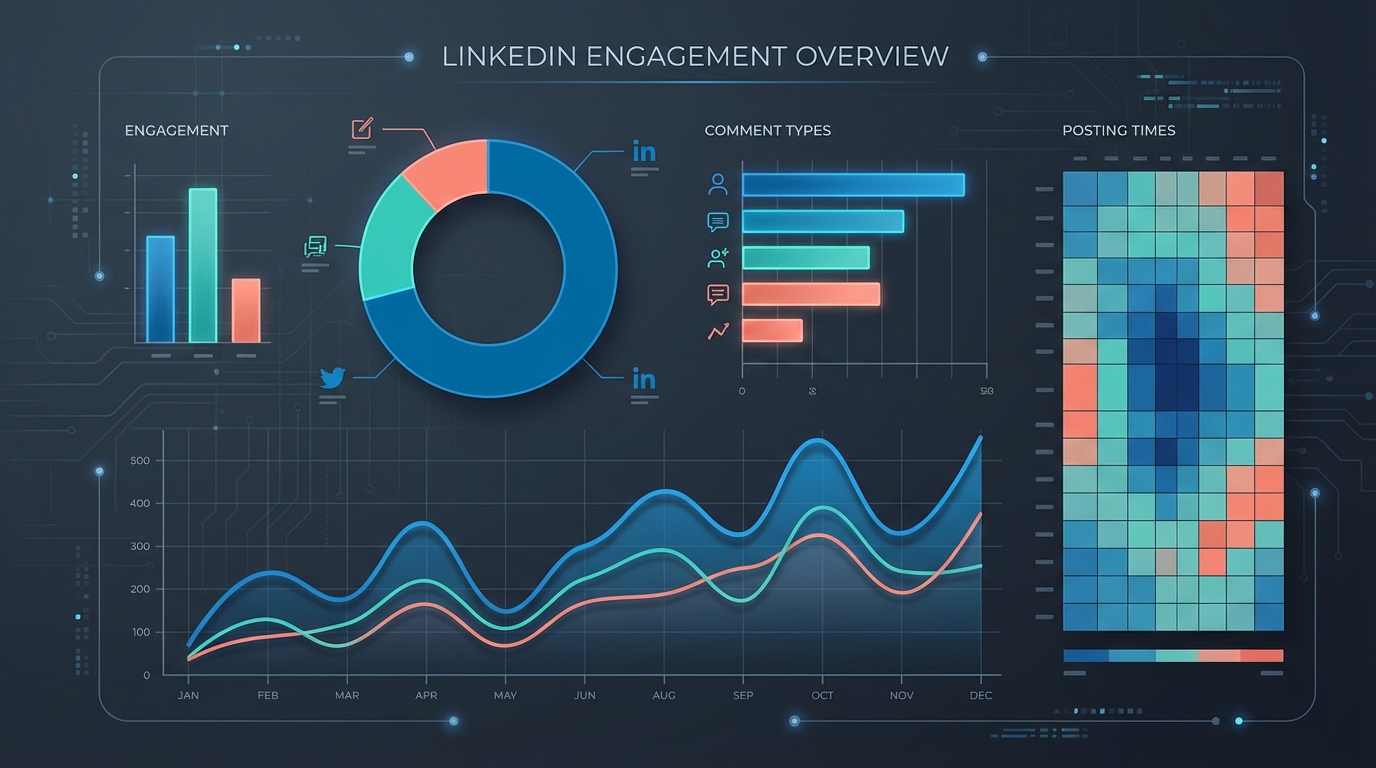
Engagement breakdown by type: The average LinkedIn post receives engagement in this approximate distribution: 70% reactions (likes, celebrates, etc.), 20% comments, 8% shares, and 2% clicks to external links. Comments, while representing a smaller share of total engagement, carry far more weight in the algorithm and generate more downstream activity.
For a deeper analysis of how to improve your own metrics, see our guide on how to increase LinkedIn engagement rate.
How Comments Drive More Engagement Than Posts
This is the most counterintuitive statistic in LinkedIn engagement data: for most professionals, commenting on other people’s posts generates more business value per hour than creating their own posts.
Reach efficiency. The average LinkedIn post from an account with 2,000 followers reaches 300 to 800 people. A thoughtful comment on a post from a creator with 50,000 followers is visible to a significant portion of that much larger audience. The reach per minute invested is dramatically higher for commenting.
Profile views per activity. Our data shows that a substantive comment on a high-visibility post generates an average of 5 to 15 profile views. A typical LinkedIn post from a non- influencer account generates 8 to 20 profile views. Given that a comment takes 2 to 3 minutes to write and a post takes 20 to 30 minutes, the profile views per minute ratio strongly favors commenting.
Connection request generation. Profile views from comments convert to connection requests at a higher rate (12-18%) than profile views from posts (6-9%). This is because someone who clicks on a commenter’s profile is actively curious about that person, whereas post-driven profile views often come from casual browsing.
Algorithm amplification. LinkedIn’s 2026 algorithm heavily rewards posts that generate meaningful comment threads. When you write a substantive comment that triggers replies, the post gets an algorithmic boost. This creates a positive feedback loop: your comment helps the post reach more people, which means more people see your comment. For more on this mechanism, see our analysis of how LinkedIn’s algorithm ranks comments.
Conversation initiation. Data from B2B sales teams shows that 34% of LinkedIn-sourced sales conversations in 2026 originated from a comment interaction rather than a direct message or post. Commenting creates a natural, low-pressure conversation starter that DMs and InMails cannot replicate.
LinkedIn Algorithm Changes in 2026
LinkedIn’s algorithm has evolved significantly, with several changes that directly impact engagement strategy.
Conversation quality weighting. The algorithm now assigns significantly more weight to comments that generate replies versus comments that receive only reactions. A comment that sparks a three-reply thread provides more algorithmic benefit to the post (and more visibility to the commenter) than a comment that gets ten likes but no replies.
AI content signals. LinkedIn has introduced signals to identify potentially AI-generated content. Posts and comments flagged as AI-generated without human engagement patterns (such as not responding to replies or posting at inhuman speeds) receive reduced distribution. This does not penalize AI-assisted content broadly, but it does penalize fully automated, low-effort AI content.
Extended content shelf life. The algorithm now resurfaces older posts that receive new meaningful comments. This means commenting on a post that is 24 or even 48 hours old can still provide significant visibility, whereas previously the window was much narrower. Posts with ongoing comment threads remain in feeds longer.
Cross-network reach. Comments from users outside the poster’s immediate network now receive additional weight. This means that commenting on posts from people you are not connected to can be more valuable than commenting on connections’ posts, because the algorithm sees cross-network engagement as a stronger signal of content quality.
Creator mode updates. Creator mode profiles see their comments distributed more broadly when commenting outside their usual topic areas. LinkedIn is encouraging subject-matter experts to engage across topics, and the algorithm rewards this diversity of engagement.
Industry-Specific Engagement Benchmarks
Engagement rates vary substantially by industry. Knowing your industry’s benchmark helps you set realistic targets.
Technology and SaaS: Average engagement rate of 3.2%. Technology content tends to attract engaged but demanding audiences. Comments on tech posts tend to be longer and more substantive, with above-average reply rates.
Financial Services: Average engagement rate of 2.1%. Compliance concerns limit some engagement, but thought leadership content performs exceptionally well. Financial services professionals who comment strategically report among the highest ROI from LinkedIn activity.
Healthcare and Pharma: Average engagement rate of 2.5%. Healthcare content generates strong engagement, particularly around workforce issues, technology adoption, and patient care innovation. Regulatory sensitivity requires careful content positioning.
Professional Services (Consulting, Legal, Accounting): Average engagement rate of 3.8%. This sector sees the highest engagement rates outside of career and recruitment content. The audience actively seeks expertise and is highly responsive to thought leadership.
Marketing and Advertising: Average engagement rate of 4.2%. The marketing community is extremely active on LinkedIn, creating both high engagement and high competition for attention. Standing out requires either strong data or contrarian perspectives.
Manufacturing and Industrial: Average engagement rate of 1.8%. Lower overall engagement but highly valuable when it occurs. Decision makers in manufacturing are less frequent users but tend to be highly engaged when they are on the platform.
Education and Non-Profit: Average engagement rate of 4.5%. Among the highest engagement rates, driven by mission- driven content that resonates emotionally. Comments tend to be supportive and discussion-oriented.
Real Estate: Average engagement rate of 3.0%. Market insights and trend analysis drive the strongest engagement. Local market expertise comments perform particularly well on national trend posts.
The Best Times to Comment on LinkedIn
Timing affects comment visibility more than most professionals realize. Here is what the data shows.
Optimal posting days. Tuesday through Thursday consistently generate the highest engagement across all content types. Monday engagement is moderate as users ease into the work week. Friday engagement drops significantly after noon. Weekend engagement is lowest but has been growing as more professionals browse LinkedIn during personal time.
Optimal posting hours. The highest engagement windows are 8:00 to 10:00 AM and 12:00 to 1:00 PM local time. The morning window captures professionals checking LinkedIn during their first work session. The midday window captures lunch-break browsing. A secondary peak occurs between 5:00 and 6:00 PM as people wind down their workday.
Optimal commenting time. This is the critical distinction. The best time to post and the best time to comment are different. For commenting, the most important metric is not the time of day but the age of the post. Comments posted within the first 30 minutes of a post going live receive approximately 5x more visibility than comments posted after 2 hours. Comments posted within the first hour get 3x more visibility.
This means the ideal commenting strategy is not about picking the right time of day. It is about identifying high-potential posts early and commenting quickly. Setting up notifications for key creators and industry thought leaders ensures you see their posts when they are fresh.
Late commenting value. That said, the 2026 algorithm change that extends content shelf life has made late commenting more viable. A substantive comment on a post that is 12 to 24 hours old can still generate visibility, especially if it adds a perspective not covered in earlier comments. The key is that late comments need to be more substantive to justify their position in an already-developed thread.
How Top LinkedIn Users Achieve 10x Engagement
The top 1% of LinkedIn users generate engagement rates 10 times higher than the average. Our analysis of these top performers reveals consistent patterns.
They comment more than they post. Top performers spend 60% to 70% of their LinkedIn time commenting on other people’s posts and 30% to 40% creating their own content. This ratio inverts the typical user behavior, where most people focus primarily on posting and comment sporadically.
They respond to every comment. Posts from top performers have response rates above 80% on comments. When someone comments on their post, they reply. This creates longer comment threads, which the algorithm interprets as high-quality conversation, which increases post distribution, which attracts more comments. It is a virtuous cycle.
They comment early and often on strategic posts.Top performers monitor key accounts and comment within minutes of a new post going live. They are consistently among the first three to five commenters on posts from industry leaders, which ensures their comments are seen by the maximum number of people.
They add genuine value in comments. Comments from top performers average 50 to 100 words and include specific insights, data points, or personal experiences. They never leave “Great post!” comments. Every comment contains information that the reader would not get from the original post alone.
They maintain a consistent schedule. Top performers engage daily without exception. Consistency signals to the algorithm that you are an active, valuable member of the community. Sporadic engagement, even if individually high-quality, produces weaker algorithmic results than consistent daily activity.
They use their comments strategically. About 15% to 20% of comments from top performers include some reference to their work, expertise, or business. This ratio provides enough visibility for their professional brand without triggering the perception of spam. The balance between value and promotion is deliberate and consistent.
Key Takeaways for Your LinkedIn Strategy
The data points to several clear conclusions for LinkedIn strategy in 2026.
1. Commenting is undervalued. The ROI of strategic commenting exceeds the ROI of posting for most professionals, particularly those with fewer than 10,000 followers. Reallocate time from content creation to strategic commenting.
2. Speed matters. Early comments get disproportionate visibility. Develop systems (notifications, tools, or routines) that let you comment on high-potential posts within 30 minutes of publication.
3. Quality over quantity. One substantive comment generates more value than ten “Great post!” comments. The algorithm and human readers both reward depth.
4. Consistency beats intensity. Commenting thoughtfully on five posts daily is more effective than commenting on 50 posts once a week. Build a daily commenting habit.
5. Your industry baseline matters. Compare your engagement rates to industry benchmarks, not to LinkedIn influencers. A 3% engagement rate in financial services is excellent. A 3% rate in marketing is below average.
6. AI-assisted commenting is the new norm. The question is not whether to use AI for LinkedIn engagement but how to use it effectively. Tools that match your voice, maintain quality, and avoid detectable patterns provide a significant competitive advantage over both manual commenting and generic AI tools.
For a comprehensive strategy that applies these statistics to your daily LinkedIn activity, see our complete LinkedIn commenting strategy guide.