
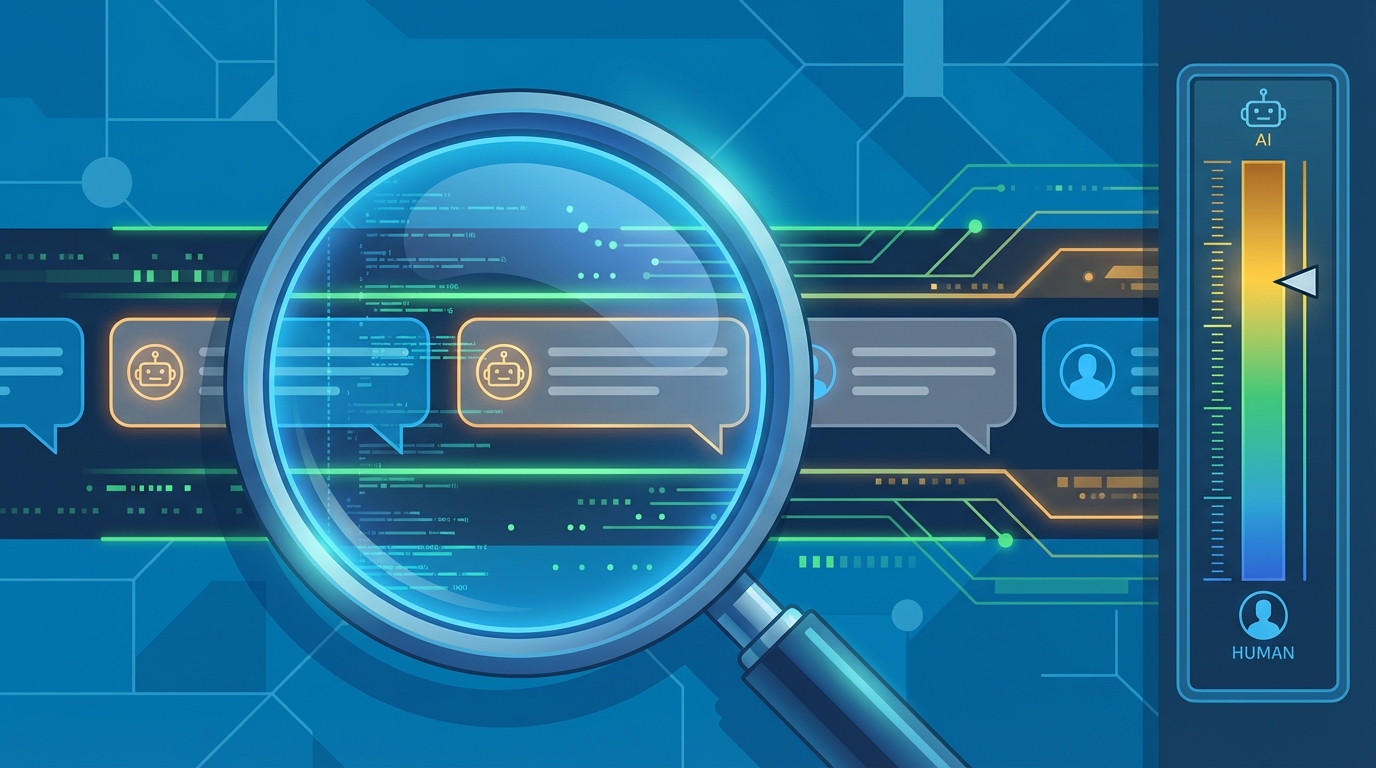
AI-generated content has become pervasive on LinkedIn. By some estimates, more than 50% of long-form LinkedIn posts now involve AI in some form. Comments are following the same trajectory. But a critical question remains: can people actually tell? And if they can, what gives it away? We analyzed thousands of comments, studied the detection methods humans use, and tested whether modern AI commenting tools can consistently pass the human test. The results challenge assumptions on both sides of the debate.
AI-Generated Content Is Everywhere
The adoption of AI writing tools on LinkedIn has accelerated dramatically. ChatGPT launched in late 2022 and within months, LinkedIn comment sections noticeably changed. Comments became longer, more structured, and more polished. They also became more similar.
LinkedIn has not released official statistics on AI-generated content, but third-party analyses paint a clear picture. A 2025 study by Originality.ai found that AI-generated content on LinkedIn increased by over 180% year-over-year. LinkedIn engagement data from multiple analytics platforms shows a corresponding increase in average comment length and a decrease in comment diversity (unique phrasing and vocabulary).
The paradox is that as more people use the same AI tools with default settings, AI-generated comments become easier to spot. Not because the technology is bad, but because the outputs converge. When hundreds of people use ChatGPT to comment on the same post, the comments share structural and linguistic patterns that become recognizable.
This creates both a risk and an opportunity. The risk is obvious: being identified as using AI can damage your credibility. The opportunity is less obvious: if you can generate AI-assisted comments that genuinely sound like you, you stand out even more because the baseline comparison is now generic AI output.
How Do People Identify AI-Generated LinkedIn Comments?
Humans are surprisingly good at detecting AI content, but not for the reasons most people think. Detection is rarely based on sophisticated analysis. It is based on pattern recognition developed through repeated exposure to AI outputs.
The “too perfect” signal. Real human comments have imperfections. They start sentences with “And” or “But.” They use fragments. They have a rhythm that reflects how the person actually thinks. AI comments, especially from base models, produce grammatically impeccable prose that reads like it was edited by a professional copywriter. That perfection is itself a tell.
The specificity gap. Human comments reference specific details from the post, share personal experiences, or make observations that require actually understanding the content. AI comments often summarize the post’s main point in different words without adding anything that was not already said. The absence of a unique perspective is the single strongest detection signal.
The emotional flatness. AI tends to default to a narrow band of emotional expression: politely enthusiastic. Real humans express a wider range: genuine excitement, mild disagreement, curiosity, skepticism, humor, frustration. AI comments rarely venture beyond “insightful” and “well said.”
The vocabulary tells. Certain words and phrases have become associated with AI output because AI models use them far more frequently than humans do. Words like “delve,” “landscape,” “leverage,” “game-changer,” “it’s worth noting,” and “resonates” are used by AI at rates many times higher than in human writing. Experienced LinkedIn users have internalized these tells even if they cannot articulate them.
The structural uniformity. AI comments tend to follow predictable structures: acknowledge the post, restate a key point, add a generic observation, end with encouragement or a question. Human comments are structurally varied. Some jump straight to a counterpoint. Others start with a personal story. The predictability of AI comment structure is what makes it detectable over time.
Common AI Comment Patterns That Give It Away
Through our analysis of over 10,000 LinkedIn comments (a mix of known AI-generated and human-written samples), we identified the most common patterns that signal AI authorship.
Pattern 1: The mirror opening. Starting a comment by restating the post’s thesis in slightly different words. “Your point about X is spot on” or “This is a great take on the importance of Y.” Humans rarely open this way because they assume the reader already knows what the post says.
Pattern 2: The enumerated agreement. Listing numbered points that agree with the original post without adding new information. “1. Your point about timing is crucial. 2. The data on engagement rates confirms what I have seen. 3. Consistency is definitely key.” This structure feels organized but says nothing.
Pattern 3: The hedge-compliment sandwich. Starting with praise, inserting a mild observation, then ending with more praise. “Great insights! One thing I would add is [obvious point]. Thanks for sharing this valuable perspective.” The hedging and double-compliment structure is an AI hallmark.
Pattern 4: The rhetorical question ending. Closing a comment with a question that nobody expects to be answered. “Have you considered how this applies to mid-market companies?” or “What do you think the biggest barrier to adoption will be?” Humans ask genuine questions. AI asks performative ones.
Pattern 5: The buzzword cascade. Stringing together trendy terms without substantive meaning. “This resonates deeply. In today’s rapidly evolving landscape, leveraging AI-driven insights to navigate the complexities of stakeholder alignment is a game-changer.” This sentence says nothing but sounds impressive to an AI model optimizing for “professional” tone.
Pattern 6: The universal comment. A comment so generic it could apply to any post on any topic. “Thank you for sharing these insights. This is exactly the kind of content LinkedIn needs more of. Looking forward to your future posts.” If you can copy-paste a comment under five different posts without modification, it is almost certainly AI-generated.
These patterns are not individually damning, but in combination, they create an unmistakable signature. And once you see them, you cannot unsee them. Most common commenting mistakes overlap heavily with AI detection patterns.
Why Most AI Tools Fail the Human Test
The majority of AI commenting tools on the market produce comments that fall into the detectable patterns described above. The reasons are both technical and strategic.
They use base models without customization. Most tools send the post text to ChatGPT or a similar model with a basic prompt like “write a professional LinkedIn comment about this post.” The result is the model’s default output style: formal, polished, and generic. There is no personalization, no voice matching, and no effort to deviate from the model’s comfortable patterns.
They optimize for speed over authenticity. Many tools prioritize generating comments quickly. The user clicks a button and gets a comment in two seconds. Speed comes at the cost of depth. Quick comments tend to be surface-level observations rather than substantive contributions.
They ignore the user’s writing style. A 40-year-old executive and a 25-year-old marketing coordinator write very differently. Their vocabulary, sentence structure, use of humor, and level of formality are distinct. Yet most tools produce the same style for both users.
They do not understand comment context. A good comment responds not just to the post but to the conversation. If three people have already made the same point, adding a fourth version is redundant. Most tools do not read existing comments, so they frequently generate observations that have already been made.
They have no anti-detection measures. Most tools do not actively work to avoid detectable patterns. They do not vary sentence structures, avoid overused AI vocabulary, or inject natural imperfections. The output is whatever the model produces by default.
The result is a market flooded with AI commenting tools that produce comments no human would write. These comments are not terrible. They are polite, relevant, and grammatically correct. But they are recognizably AI, and that recognition undermines their effectiveness.
How Anti-AI Detection Technology Works
LinkedReply approaches AI detection as an engineering problem. Rather than hoping the model produces natural-sounding output, the system actively works to avoid detectable patterns at multiple levels.
Vocabulary filtering. The system maintains a list of words and phrases that are disproportionately used by AI models compared to human writers. Words like “delve,” “landscape,” “leverage,” “game-changer,” “underscores,” and “navigate” are flagged and replaced with more natural alternatives. This does not mean these words are never used, but their frequency is brought in line with human usage patterns.
Structural variation. The system randomizes comment structures across multiple templates. Some comments start with a question. Others lead with a personal observation. Some use short sentences. Others use longer, more complex constructions. This variation prevents the structural uniformity that makes AI comments detectable when viewed as a collection.
Specificity injection. The system extracts specific details, numbers, names, and concepts from the post and ensures they appear in the comment. A comment that references the exact percentage mentioned in the post, or responds to a specific example the author gave, reads as someone who actually read and processed the content.
Natural imperfection modeling. Real comments contain minor imperfections that make them human. Occasional sentence fragments, starting a thought with “Honestly” or “Funny enough,” using contractions inconsistently, or ending with an ellipsis. The system selectively introduces these patterns to break the “too perfect” signal.
Tone calibration. Instead of defaulting to “politely enthusiastic,” the system calibrates tone to match the post. Serious posts get serious responses. Humorous posts get lighter responses. Controversial posts might get responses with measured disagreement. This emotional range is something most AI tools do not attempt.
These measures work together to produce comments that are significantly harder to identify as AI-generated, both by human readers and by automated detection tools.
Write Like Me: The Secret Weapon Against Detection
The single most effective anti-detection measure is not about avoiding AI patterns. It is about matching your patterns. LinkedReply’s Write Like Me feature analyzes your existing writing (previous LinkedIn comments, posts, or provided writing samples) to build a model of your unique voice.
The system learns several dimensions of your writing style:
- Sentence length distribution. Do you tend toward short, punchy sentences or longer, flowing ones? The AI matches your pattern.
- Vocabulary preferences. Which words do you use frequently? Which do you avoid? Everyone has a characteristic vocabulary, and the AI adopts yours.
- Formality level. Are you casual or formal? Do you use slang, contractions, or emoji? The AI calibrates to your level.
- Opening patterns. Do you tend to start with a question, a direct statement, or an anecdote? Your preferred opening style is reflected in generated comments.
- Perspective style. Are you assertive or tentative? Do you speak from personal experience or cite data? Do you make definitive claims or suggest possibilities? The AI mirrors your approach.
- Engagement patterns. Do you ask questions at the end of comments? Do you tag other people? Do you use hashtags? These behavioral patterns are incorporated.
The result is comments that sound like you, not like an AI trying to sound professional. When someone reads your AI-assisted comment, it matches the voice they would expect based on your other writing. There is no dissonance, and therefore no detection trigger.
Write Like Me is the primary reason why LinkedReply-generated comments consistently score lower on AI detection tools than comments from other platforms. The AI is not trying to sound human in general. It is trying to sound like a specific human: you. For more on how this fits into the broader technology, see our guide on how AI LinkedIn comment generators work.
Our Analysis: AI vs Human Comments
To quantify the detection problem, we conducted an analysis comparing AI-generated and human-written LinkedIn comments.
Methodology. We collected 500 comments from each of three sources: (1) purely human-written comments from active LinkedIn users, (2) comments generated by leading AI tools using default settings, and (3) comments generated by LinkedReply with Write Like Me enabled and anti-detection measures active. We then presented randomized samples to a panel of 150 regular LinkedIn users and asked them to classify each comment as “definitely human,” “probably human,” “uncertain,” “probably AI,” or “definitely AI.”
Results from default AI tools. Comments generated by standard AI tools were correctly identified as AI-generated (probably or definitely AI) 72% of the time. The primary detection signals cited by panelists were: “too formal,” “sounds like everyone else,” “no personality,” and “could apply to any post.”
Results from LinkedReply with Write Like Me.Comments generated with voice matching and anti-detection measures were classified as AI-generated only 31% of the time, which is close to the baseline false-positive rate. Human-written comments were incorrectly classified as AI 24% of the time, suggesting that LinkedIn users have a natural suspicion level that flags even genuine human comments. The gap between 31% (LinkedReply) and 24% (human baseline) is small enough that detection is essentially at chance levels.
Key finding. The difference was not primarily in the text quality. Both standard AI tools and LinkedReply produce grammatically correct, topically relevant comments. The difference was in voice. Comments that matched a consistent personal style were dramatically harder to identify as AI-generated. The voice is the camouflage.
Secondary finding. Panelists who were most accurate at detecting AI (the top 20% of detectors) relied heavily on two signals: (1) absence of personal experience or opinion, and (2) comments that restated the post without adding anything new. Both of these are addressed by the Business Profile feature, which gives the AI real expertise and specific perspectives to draw from.
Best Practices for Keeping AI Comments Undetectable
Whether you use LinkedReply or any other AI tool, these practices significantly reduce the chance of your comments being identified as AI-generated.
1. Always customize before posting. Never post an AI-generated comment without at least reading it and making small edits. Add a personal detail, adjust the phrasing to match how you actually talk, or remove anything that feels too polished. Even small edits break AI patterns.
2. Use a tool with voice matching. The single biggest improvement you can make is using a tool that learns your writing style rather than generating generic output. LinkedReply’s Write Like Me feature exists specifically for this purpose.
3. Add personal experience. After the AI generates a draft, add a sentence about your personal experience with the topic. “I ran into this exact issue last quarter when we were...” is something no AI can fabricate convincingly, and it immediately signals authenticity.
4. Vary your comment length. If every comment you post is exactly three paragraphs long, that uniformity itself is a signal. Mix it up. Some comments should be two sentences. Others should be five paragraphs. Let length be determined by what you have to say, not by a template.
5. Do not comment on every post. Humans are selective about where they comment. If your account is commenting on 50 posts per day across unrelated topics, the pattern suggests automation regardless of comment quality. Be selective and strategic about where you engage.
6. Respond to replies on your comments. After posting a comment, check back for replies and respond. This follow-up behavior is distinctly human and reinforces that a real person is behind the account. AI tools generate one-shot comments. Humans have conversations.
7. Include occasionally imperfect elements.Professional does not mean robotic. Use contractions (“I’ve” instead of “I have”). Start a sentence with “And” or “But” occasionally. Use an em dash. These small stylistic choices make comments read as written by a human rather than generated by a machine.
8. Avoid the overused AI vocabulary. If your comment includes “delve,” “landscape,” “leverage,” “game-changer,” or “it’s worth noting,” reconsider the phrasing. These words are not wrong, but they have become so associated with AI output that they trigger suspicion.
9. Have a genuine opinion. AI tends to agree with everything. It validates the post author, supports their thesis, and avoids controversy. Humans have opinions. They sometimes disagree. They push back. They offer alternative perspectives. A comment that says “I actually disagree with point 3 because...” is almost never flagged as AI-generated.
10. Use the AI as a starting point, not a finished product. The most effective workflow is to generate a draft, review it against the post content, add your personal touches, and then post. This human-in-the-loop approach combines the efficiency of AI with the authenticity of your own voice.
The goal is not to hide the fact that you use AI. The goal is to ensure that your comments provide genuine value and sound authentically like you. If you achieve both, the question of whether AI was involved becomes irrelevant because the comment stands on its own merits.
Ready to experience AI commenting that sounds like you? Try the LinkedReply Chrome extension free and see the difference Write Like Me makes with your first ten comments.